
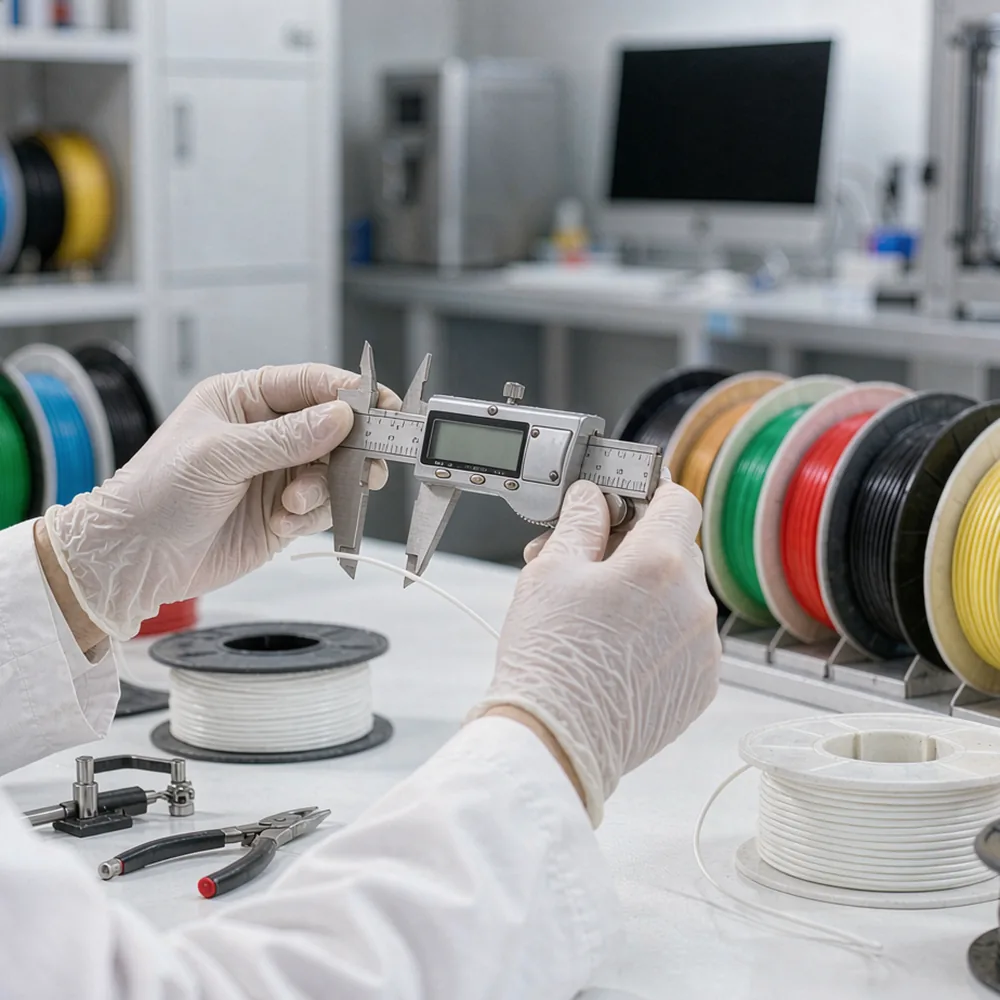
A supplier’s website can say anything. Certificates can be borrowed, photos can be licensed, and a polished video tour can be filmed on the one good day of the year. That is exactly why serious buyers — anyone planning to put their own brand on a spool — increasingly commission a third-party factory audit before the first purchase order.
But an audit is only as useful as your understanding of what it actually covers. This article walks through a filament factory audit the way an inspector walks the floor: area by area, with the checks performed, the documents requested and the red flags that should end a conversation early.
The structure below reflects how SGS-, TÜV- and Bureau Veritas-style audits are typically scoped for a plastics extrusion plant, combined with filament-specific checks that a generic plastics auditor may miss unless you brief them.
Who Performs the Audit — and on What Standard
- Third-party inspection firms (SGS, TÜV SÜD, Bureau Veritas, QIMA and regional equivalents) run the most common format: a one-day, on-site supplier assessment against a checklist you define or they provide. Cost typically runs $300–900 per man-day in China, plus expenses.
- ISO 9001 certificates are worth checking but not trusting blindly — verify the certificate number against the issuing body’s registry, confirm the scope actually covers filament extrusion, and check the issue and expiry dates. An expired or out-of-scope certificate is itself a finding.
- Filament-specific additions matter: a generic plastics audit will check a warehouse and a QC lab, but it will not know to question laser micrometer calibration records or drying schedules per material. Brief the auditor with a filament checklist — the 9-point vetting checklist works as a briefing document.
The Audit Day, Hour by Hour
A well-scoped one-day audit for a filament plant typically unfolds like this:
| Time | Area | What the auditor does |
|---|---|---|
| 08:30–09:30 | Opening meeting & documents | Reviews business license, ISO certificates, org chart, QC procedures; confirms scope of the visit |
| 09:30–10:30 | Raw material warehouse | Checks pellet storage (dry, off-floor, labeled by lot), supplier records for masterbatch, and whether resin lots are traceable to incoming test records |
| 10:30–11:30 | Pre-processing | Verifies drying ovens and moisture meters are running and logged — wet pellets are the root cause of bubbles and brittleness, and the single most common shortcut |
| 11:30–13:00 | Extrusion floor | Walks the lines: closed-loop diameter control, line speeds, operator discipline, whether settings are posted and followed or adjusted ad hoc |
| 13:00–14:00 | QC lab | Checks laser micrometers and calipers against calibration stickers, reviews diameter trend charts, spool weight checks, melt-flow and tensile test records |
| 14:00–15:00 | Winding & packing | Spool winding tension, vacuum sealing, desiccant insertion, carton weights, labeling accuracy and batch coding |
| 15:00–16:00 | Finished-goods warehouse | Storage conditions, FIFO rotation, batch traceability from finished spool back to resin lot |
| 16:00–17:00 | Closing meeting | Presents findings, classifies them (critical / major / minor), agrees corrective actions and timelines |
Area-by-Area: What Gets Checked, What Should Alarm You
| Area | Healthy factory shows | Red flag |
|---|---|---|
| Raw materials | Named resin and masterbatch suppliers, lot numbers on every bag, incoming inspection records | Unlabeled bags, “whatever the trader sent” sourcing, no incoming QC |
| Drying | Moisture meter readings logged per batch; PETG dried longer than PLA | One drying schedule for everything, or ovens running “by feel” |
| Extrusion | Closed-loop laser measurement, documented temperature profiles per material | Manual diameter checks once per shift, operator-adjusted tolerances |
| QC lab | Calibrated laser micrometer, MFI tester, tensile tester, diameter SPC charts with real data | Lab equipment present but dusty; charts with straight-line “perfect” data that no process produces |
| Packing | Vacuum seal integrity checks, desiccant, batch code on every spool and carton | Shrink-wrap only, no batch codes — meaning no recall path and no way to match a complaint to a production day |
| Traceability | Pick any finished spool and trace it back to resin lot, extrusion line and operator within minutes | “We would have to check with the supervisor” — traceability that lives in someone’s head does not exist |
| Social & compliance | Working hours records, safety equipment in use, fire exits clear | Locked exits, missing machine guards, no overtime records |
The QC lab deserves extra attention. A factory can survive a messy warehouse; it cannot survive dishonest measurement. Ask to see the diameter trend chart for a running line, not the certificate on the wall — a real process oscillates gently inside the tolerance band; a flat line usually means the chart was drawn, not recorded. Our article on QC and batch testing covers what the lab should be measuring.
Documents to Request Before the Visit
- Business license and ISO 9001 certificate (verify the registry entry yourself)
- Resin and masterbatch supplier list with incoming inspection records
- Laser micrometer / measuring equipment calibration certificates
- A sample batch record: from resin lot to finished spool, one production day end to end
- Recent test reports — diameter distribution, MFI, tensile strength — ideally on the exact material you intend to buy
- Two customer references you can call, ideally in your market segment
Send this list before confirming the audit date. How completely and quickly a factory responds to a document request is itself an audit finding — and a free one.
Six Red Flags That Should End the Conversation
- The factory refuses the audit or proposes “any day next month” for weeks. An operating factory can host a visitor with 48 hours’ notice.
- The tour follows a route that never passes a running QC station. Bad news hidden on purpose is worse than bad news found.
- They offer to rebrand another factory’s goods for you without saying so. Trading dressed as manufacturing means every QC promise is secondhand.
- Diameter tolerance quoted below ±0.02 mm at commodity prices. Physically possible, economically not sustainable — something else is being cut. The price-range breakdown shows what plausible quotes look like.
- No batch codes on spools. Without them, no traceability, no recalls, no accountability — and no defense when a customer complaint lands on you.
- Answers change between the salesperson and the production manager. Ask the same tolerance question to both; if the numbers differ, the salesperson is selling a spec the floor does not hold.
Cannot Travel? Remote and Sample-Based Verification
A full on-site audit is the gold standard, but it is not the only verification path — and for a first small order it may not be proportionate:
- Live video walkthrough on a scheduled call, with the camera asked to go where you direct it — not where the host leads it. Ask, on camera, to see a running line’s diameter display and today’s QC log.
- Independent sample testing: have a sample order shipped to a local lab (or simply to yourself) and measure diameter distribution, spool weights and print behavior. A structured sample order tests the product even when you cannot test the plant.
- Third-party inspection during production: an inspector visits mid-run, photographs the lines, pulls random spools off the line and sends them to you before shipment approval. Typically $150–300 per visit — proportionate protection once order values grow.
In practice the path most buyers take is: sample order first, then a mid-production inspection on the first bulk order, then a full audit before signing an OEM or private-label agreement — the point where the factory’s process becomes your brand’s quality. The OEM and private-label guide explains what changes at that stage.
Quick FAQ
How much does a third-party filament factory audit cost?
For a one-day on-site audit in China, expect roughly $300–900 in fees plus travel expenses, depending on the firm and report depth. A mid-production inspection is cheaper, around $150–300. Against the cost of a bad container — returns, rework, brand damage — it is inexpensive insurance, and it is most justified the moment you commit to exclusive tooling, custom colors or your own label.
Will the factory be offended if I ask for an audit?
Established manufacturers expect it and usually welcome it — they pass such audits for a living. Evasive or offended reactions are themselves informative: the confident answer is “come any working day”. If a supplier resists, ask why, and watch whether the objections are logistical (plausible) or substantive (not).
How long do the results take and what do I get?
A typical engagement delivers a written report with photo evidence within 2–5 working days of the visit: findings classified as critical, major or minor, plus corrective-action recommendations. Insist on photos taken during the visit — a report without a timestamped photo of the laser micrometer in use is a report you cannot act on.
Next Step: Visit Ours
An audit is the strongest trust signal a buyer can run — which is why we invite it. Learn about our factory, then tell us your schedule: we welcome third-party audits, live video walkthroughs and mid-production inspections on any order, and we will hand you the batch records before you ask. If you are building a supplier shortlist, start the conversation here — and for background on what separates a filament plant from a trading company, the factory guide for B2B buyers is a useful primer.
Leave a Reply