
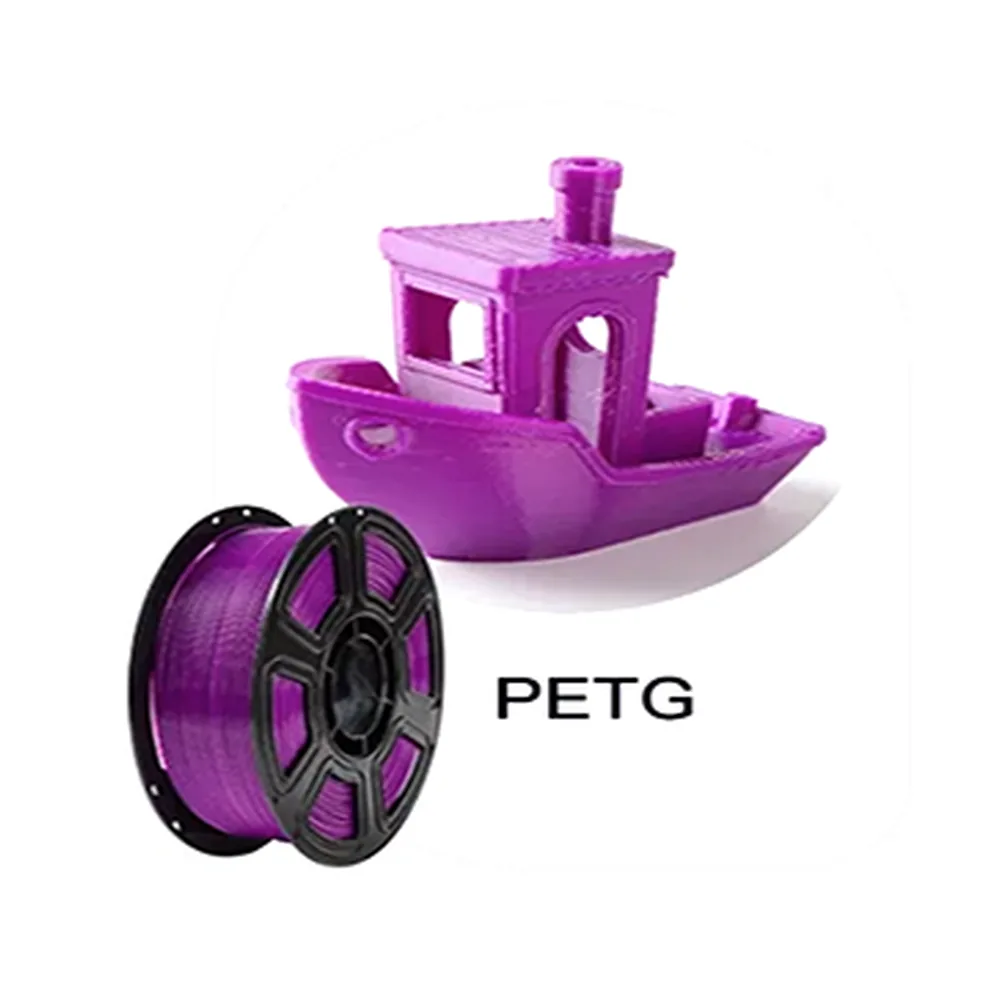
Walk into a well-run filament retail shop or scroll through a serious online store’s bestseller list in 2026, and one material keeps climbing: PETG. Five years ago it was the niche “technical spool” sitting next to ABS; today it is the default second material after PLA — and in many stores, the first.
That shift is not marketing. It comes down to wholesale economics: PETG costs almost the same as PLA at the factory gate, but it generates fewer complaints, fewer returns and more repeat purchases. This article breaks down the numbers behind the shift, and what to check before you give PETG a permanent shelf slot.
The figures below reflect typical factory-direct and retail price levels in 2026, rounded for readability. Treat them as planning baselines, not fixed quotes.
The Short Answer: Four Reasons Retailers Are Switching
- Fewer complaints per spool sold. PETG is forgiving: it does not warp like ABS, it is not brittle like commodity PLA, and it tolerates the imperfect settings that first-time buyers actually use. Fewer failed prints means fewer support tickets and refunds — the quiet margin killer in filament retail.
- Wholesale price sits at PLA level. PETG’s premium appears at retail, not at the factory. You pay roughly the same per kilogram, and you can charge more for it.
- It works on the machines customers actually own. PETG prints reliably on entry-level FDM printers with a heated bed — no enclosure, no exotic hardware, no customer-service education program.
- Demand is expanding beyond hobbyists. Functional users — brackets, enclosures, outdoor fixtures, replacement parts — buy filament to solve a problem, and they restock. They are also far less price-sensitive than hobby buyers.
The Wholesale Economics, Side by Side
| Metric | Commodity PLA | PETG | What it means for a retailer |
|---|---|---|---|
| Factory-direct price | $4–8 / kg | $4–8.5 / kg | Effectively price parity at the gate |
| Typical retail price | $18–24 / kg | $22–30 / kg | PETG commands a functional-material premium at the shelf |
| Customer failure rate | Higher on structural or outdoor prints | Lower — tough, low-warp, moisture-tolerant while printing | Fewer refunds and support hours on your best-selling material |
| Repeat purchase driver | Price | Result quality | Functional buyers restock the same brand when it works |
| Shelf differentiation | Red ocean — identical spools everywhere | Still room to differentiate on color range and QC | Easier to build a brand, not just a price list |
The pattern is consistent: PLA wins the first purchase on price, PETG wins the second purchase on results. If your assortment is 100% PLA, you are optimizing for customers who may never come back.
Where PETG Demand Comes From
- Functional parts — brackets, mounts, gears, jigs. PETG’s layer adhesion and impact resistance make it the safe recommendation.
- Outdoor and moisture exposure — garden fixtures, marine parts, anything that sees water and sunlight. PLA creeps and degrades; PETG holds.
- Enclosures and boxes — chemical resistance and a clean surface finish make PETG the default for utility prints.
- Workshop and education — schools and makerspaces stock PETG because students cannot break the workflow the way they do with ABS fumes or brittle PLA.
This is also why material comparison content keeps converting: buyers arrive already convinced they need PETG and are only choosing a supplier.
What to Check Before You Stock PETG
- Diameter tolerance. PETG is slightly softer and more viscous than PLA, so sloppy extrusion shows up faster as inconsistent extrusion and stringing. Ask for ±0.02–0.03 mm and how it is measured — a laser gauge in-line is the credible answer. Our QC specification article explains what to look for.
- Drying and packing. PETG absorbs moisture faster than PLA. Spools must be vacuum-sealed with desiccant at the factory, or your return rate will be manufactured before the product even ships.
- Color range. PETG buyers are functional but not colorless — black, white, gray, clear/transparent and a few saturated colors cover most orders. A 10–12 color line lets you look serious without deep stock in every SKU. Browse a full PETG color range to see what coverage looks like.
- Spool and carton spec. Standard 1 kg spools with clear labeling, twelve per carton. Confirm net weight honesty (1,000 g, not “1 kg nominal”).
- Batch consistency. The PETG customer base skews functional — they reorder the same color for the same project. Ask the supplier how MFI and color are controlled between batches.
How Much PETG to Stock First
A sensible first PETG order mirrors the MOQ logic for any material: validate with a mixed sample order of 5–10 kg across your best-selling colors, then restock the winners at 50–200 kg. Because PETG sells at a premium with fewer returns, many retailers find they can justify deeper stock on PETG than on commodity PLA colors with the same turnover. The MOQ guide walks through typical minimums per order type.
Quick FAQ
Is PETG harder to print than PLA? Will that create support burden?
Slightly — mainly on first-layer adhesion and stringing. But because PETG fails gracefully (it rarely warps off the bed or shatters), customers experience it as “different settings” rather than “broken product”. A one-page settings card in the box, or a short guide on your product page, removes most of it. Retailers who add a settings QR code to PETG listings report the same or lower support load than PLA.
Does PETG really cost the same as PLA at wholesale?
Within rounding, yes, for standard grades. Specialty PETG — high-speed formulations, optical transparency, glass-filled — sits 20–60% higher. The 2026 wholesale price breakdown shows the ranges per material.
Which PETG colors sell first?
Black and white together usually account for 40–50% of volume, followed by gray and transparent. Saturated colors (orange, green, blue, red) are slower individually but they make the shelf look like a real product line — and they pull the DIY functional crowd. If you also carry PLA+ for impact-critical users, the two lines complement each other rather than compete.
Next Step: Put PETG on the Shelf
PETG is the rare material where the wholesale math and the customer experience point the same direction: factory pricing close to PLA, retail pricing above it, fewer returns, and a buyer base that restocks. If you are planning a first PETG order or expanding an existing range, request a quote with your target colors and volume — we will send per-kg pricing with tolerance, packing and carton specs spelled out, so you can drop it straight into your assortment plan.
Leave a Reply