
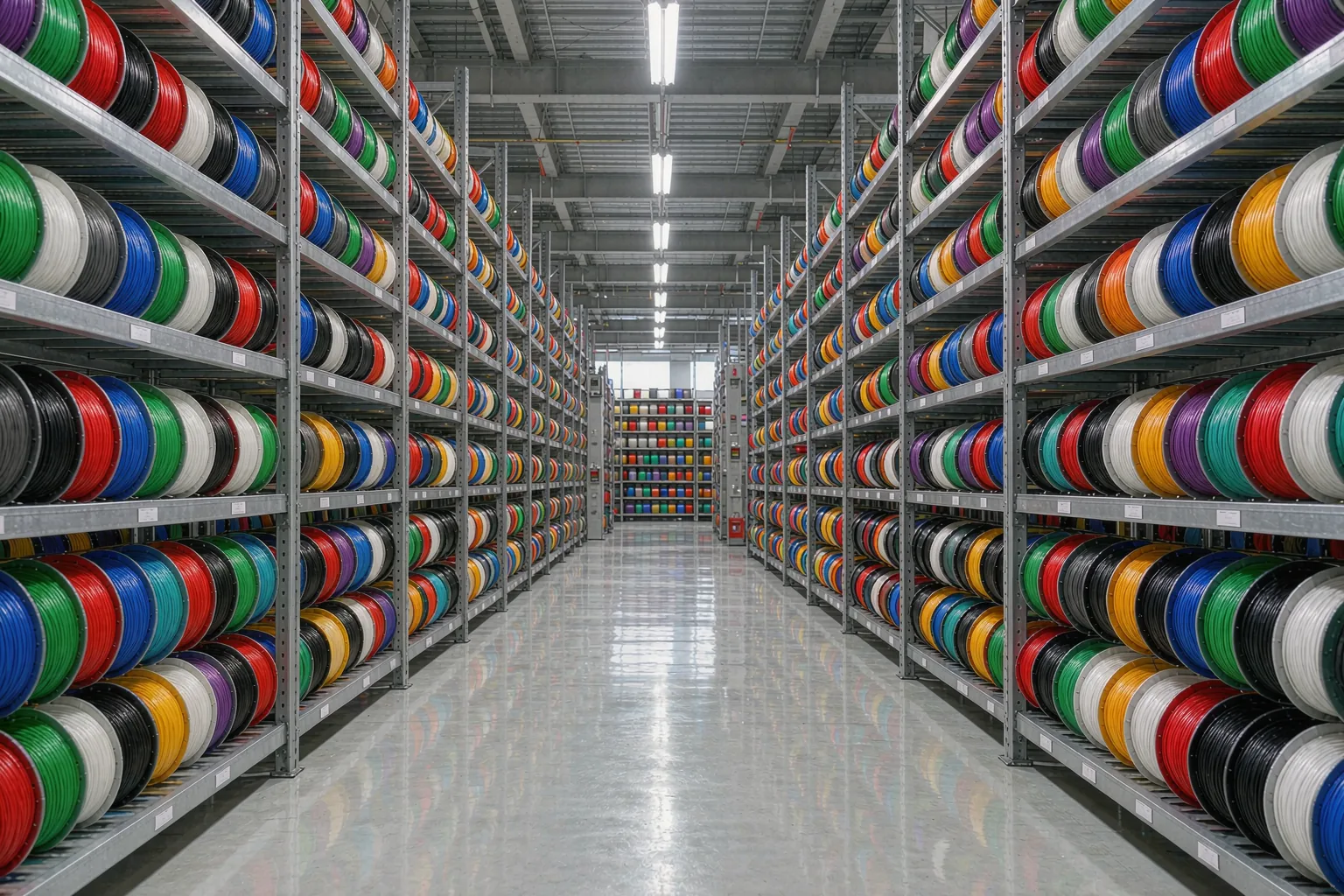
Every filament quote looks reasonable until you add freight. Buyers who have sourced from China before know the pattern: the per-kg price in the email is excellent, then the landed cost on the invoice is 30–50% higher than expected — and nobody can quite explain where the gap came from.
It usually comes from one thing: filament is a low-density product, and almost every freight decision follows from that single fact. This guide covers what shipping 3D printer filament out of China actually costs, how much fits in a container, how long it takes, and the six levers that cut the bill without cutting corners.
Rates below are indicative 2026 market levels for factory-direct shipments and are rounded for readability. Ocean freight moves weekly — use these as a planning baseline, not a fixed quote.
The One Fact That Explains Everything
A 1 kg filament spool measures roughly 200 mm across and 66 mm wide. Packed twelve to a carton, a shipping box comes out around 425 × 285 × 215 mm and weighs about 13.5 kg gross. That works out to a density of roughly 500 kg per cubic metre.
Why that number matters: ocean freight prices space against weight at a 1:1,000 ratio (one cubic metre equals one tonne). At 500 kg/m³, filament lands squarely in light cargo territory — meaning in a shared container you pay for the air around the spools, not the spools themselves.
Two consequences follow immediately:
- If you ship by LCL (shared container), the cubic metre is your unit of cost — not the kilogram. Trimming packaging volume cuts your bill directly.
- If you ship a full container, weight becomes the limit before volume does. A 40’ high cube will run out of permitted payload at roughly 52 CBM of filament, not at its 68 CBM capacity.
Four Ways to Move Filament Out of China
| Method | Typical cost | Transit time | Best for |
|---|---|---|---|
| Sea freight, FCL (full container) | $1,600–2,800 per 20GP $2,200–3,800 per 40HQ | Port to port 14–20 days to US West Coast; 30–45 days to Europe | 10 CBM and up — the cheapest per-kg option by a wide margin |
| Sea freight, LCL (shared container) | $70–130 per CBM plus destination charges | Add 7–14 days to FCL (consolidation and deconsolidation) | 3–10 CBM — a first order that is too big for air |
| Air freight | $4–7 per kg | 5–9 days door to door | Urgent restocks, 100–500 kg at a time |
| Express courier (DHL / FedEx) | $6–12 per kg | 3–6 days door to door | Samples only — 1–10 spools |
Notice where air freight sits: at $4–7 per kg, moving filament by air can cost as much as the filament itself. Air is for protecting a deadline, never for saving money. And for anything above roughly 10 CBM, a 20’ container beats LCL on both price and handling — the container is yours, sealed at the factory, and unloaded once.
How Much Fits in a Container
These are working numbers for standard 1 kg spools, packed twelve to a carton. Use them to sanity-check a quote before you ask for one.
| Container | Cartons | Spools | Net weight | Binding limit |
|---|---|---|---|---|
| 20’ standard (20GP) | ~1,050 | ~12,600 | ~12.5 t | Volume — runs out of space first |
| 40’ high cube (40HQ) | ~1,950 | ~23,400 | ~23 t | Payload — runs out of permitted weight first |
Because a 40’ container is weight-limited rather than volume-limited with filament, the per-kg ocean cost drops sharply as you scale: a 40HQ at $3,000 carrying 23,400 spools works out to about $0.13 per kg in ocean freight. Shipping the same tonnage by air would cost roughly thirty times more.
What Landed Cost Actually Looks Like
Freight is only one line. A realistic door-to-door budget for an ocean shipment of filament, per kg of product:
| Cost component | Typical range |
|---|---|
| Export handling, trucking to port, customs | $0.05–0.15 / kg |
| Ocean freight | $0.10–0.30 / kg |
| Marine insurance | ~0.3% of cargo value |
| Destination port charges & customs clearance | $0.15–0.40 / kg |
| Inland delivery to your warehouse | $0.10–0.35 / kg |
| Logistics subtotal | ~$0.60–1.50 / kg |
Against a factory-gate filament price of $4–8 per kg, that puts logistics at roughly 10–25% of landed cost — and it explains why chasing a $0.30/kg discount on the product while overpaying by $0.50/kg on freight is a losing trade.
Duties sit outside this table entirely, because they depend on your country and the HS code your broker applies. Plastics under headings 3916 and 3926 are the usual landing spot for filament, but rates, trade measures and origin rules vary — confirm with your customs broker before you budget. This is also the single biggest reason DDP pricing differs so much between suppliers: someone is absorbing (or underestimating) a duty rate they have not verified.
The Timeline, Node by Node
| Stage | Lead time |
|---|---|
| Production — stock colors | 3–7 days |
| Production — custom color or private label | 14–25 days |
| Export customs & container loading | 1–3 days |
| Ocean transit (US West Coast / Europe / Australia) | 14–20 / 30–45 / 18–25 days |
| Destination customs clearance | 2–5 days |
| Inland delivery | 2–7 days |
| Total, door to door by sea | 5–9 weeks |
| Total, door to door by air | 7–12 days |
Plan restocks against the slowest leg, not the average. Chinese New Year and the August–October peak season both add two to three weeks to production and booking, and peak surcharges (GRI and PSS) can add several hundred dollars to a container with little warning.
FOB, CIF or DDP — Which to Choose
- FOB (Free On Board) — the factory delivers to the port and handles export clearance; you control the ocean leg and destination. Cheapest overall, but you need a forwarder. Best once you ship regularly.
- CIF (Cost, Insurance, Freight) — the supplier arranges and pays ocean freight and insurance to your port. Convenient on a first order; you still handle destination charges and clearance. Verify the insurance actually covers your cargo value.
- DDP (Delivered Duty Paid) — the supplier delivers to your door with duties and taxes paid. Maximum convenience, minimum control: the duty and freight are baked invisibly into the unit price. Great for testing a new market; poor for scaling, because you cannot see what you are paying for logistics.
The pattern that works for most buyers: start DDP or CIF on the first order to remove risk, move to FOB once you know the product moves. Ask for both prices on the same quotation — a supplier who can break FOB and DDP apart cleanly is one who knows their own cost structure.
Six Ways to Cut the Freight Bill
- Cross the LCL-to-FCL line as early as you can. Above roughly 10 CBM, a 20’ container is cheaper per kg and dramatically faster — no consolidation, no shared handling, no mixed-cargo damage risk.
- Pack to the payload limit, not the volume limit. For a 40HQ of filament, ask your supplier to load to the permitted weight. An under-loaded container still costs the same.
- Choose bulk cartons over individual retail boxes when the goods are not going straight to a shelf. Retail packaging can add 25–35% to shipping volume. If your warehouse re-boxes anyway, bulk packing is free money.
- Book four to six weeks ahead. Last-minute bookings in peak season pay spot rates and surcharges; scheduled bookings do not.
- Have documents ready before the container sails. Missing paperwork causes port storage and container detention — commonly $75–200 per container per day, which can exceed the freight itself.
- Specify moisture protection, and mean it. Filament crosses the equator in a steel box. Vacuum-sealed spools with desiccant, plus container desiccant strips, are a few cents per spool against a warehouse full of returns. Our QC specification covers how spools are sealed and batch-tested before loading.
Quick FAQ
Is 3D printer filament considered dangerous goods?
No. PLA, PLA+, PETG and ABS filament are not classified as dangerous goods — they need no MSDS-class special handling, no IATA restrictions, and no special container. This is one of the reasons filament is a straightforward product to import, and why only standard commercial documents are required.
Can I mix materials and colors in one container?
Yes, and it is usually worth doing. A mixed container of PLA+, PETG and ABS lets you test several lines with one freight cost and one set of customs paperwork. The only constraint is pallet stability: heavy materials should be loaded low, and pallets must be re-strapped rather than mixed loose.
How long should filament sit before I sell it?
None at all, if it was vacuum-sealed at the factory. Sealed spools hold their moisture level for well over a year in normal warehouse conditions. Unsealed or re-packed spools should be sold within weeks or re-dried first.
Next Step: Get the Landed Number, Not the Factory Number
The most useful thing a supplier can send you is not a lower price — it is a complete picture. We quote filament with packing dimensions, carton counts and per-container loading figures attached, so you can calculate your own landed cost before you commit, and compare any two suppliers on the same basis. If you are planning a first container, tell us your target volume and destination port, and we will build the quote around it: request a shipping-inclusive quote.
Still deciding what to put in that container? Our wholesale price breakdown covers per-kg ranges by material, the MOQ guide explains minimums for custom colors, and the sample-order playbook shows how to validate quality before you fill a pallet. When you are ready to shortlist factories, the 9-point vetting checklist is a good place to start — and you can browse our PLA+, PETG and dual-color PLA-SILK ranges to see the color coverage available for a mixed load.
Leave a Reply